

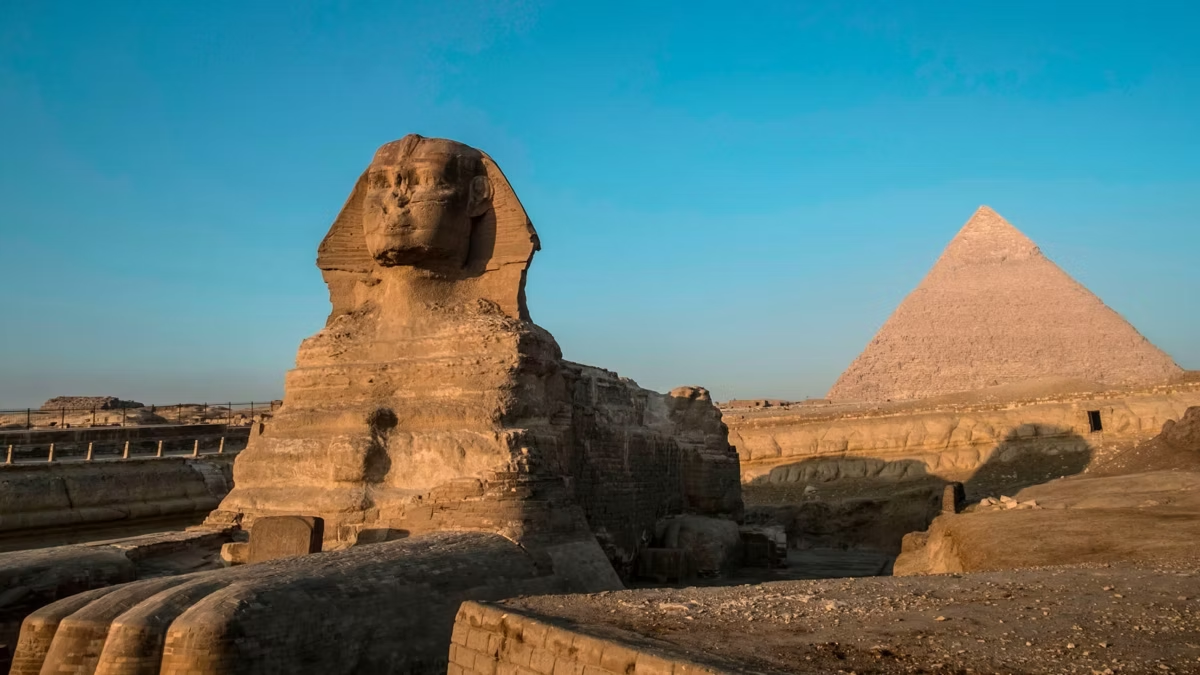
The Great Sphinx of Giza — Facts, Myths & Complete Visitor Guide 2026

The Great Sphinx of Giza is a limestone statue with a human head and lion’s body, measuring 73 metres long and 20 metres tall, carved directly from a natural limestone outcropping on the Giza Plateau around 2500 BC. It is the largest monolithic statue in the world and is almost certainly a portrait of Pharaoh Khafre, facing due east toward the rising sun. Visitors can approach the Sphinx at close range within the enclosure — included with the general area entry ticket — and visit the adjacent Valley Temple of Khafre.
The Great Sphinx is one of the most immediately recognisable monuments in the world. Yet most visitors arrive with a mental image shaped by photographs and are surprised by the experience of standing in front of it: the Sphinx is far larger than expected, far more weathered, and far more present as a physical object. Photographs flatten it; the real thing has weight, erosion, and a particular quality of ancient stillness that takes a moment to register.
This guide covers the history, the construction, the famous mysteries, and everything you need to know to plan your visit.
Key Facts
| Fact | Detail |
|---|---|
| Type | Monolithic limestone statue |
| Length | 73 metres |
| Height | 20 metres |
| Width (shoulders) | 19 metres |
| Construction date | c. 2500 BC (reign of Khafre) |
| Facing direction | Due east (toward the rising sun) |
| Associated pharaoh | Almost certainly Khafre |
| Access | Included in general area entry ticket |
| Adjacent monument | Valley Temple of Khafre |
History and Construction
The Great Sphinx was carved from a natural limestone ridge left by quarrying operations during the construction of Khafre’s pyramid. Ancient Egyptian builders shaped the existing rock formation — using the harder limestone for the body and the softer limestone layers, which have eroded more significantly, for the neck and lower portions. The face was carved separately at a higher quality of limestone than the body, which is why it has survived in better condition.
The Great Sphinx was almost certainly built during the reign of Pharaoh Khafre (c. 2558–2532 BC) of Egypt’s Fourth Dynasty, based on the proximity to his pyramid complex, the alignment of the associated temples, and the proportional similarity of the face to known Khafre portraiture. The Dream Stele of Thutmose IV — erected between the paws of the Sphinx in the 15th century BC — refers to the Sphinx by a name that translates to “Khafre’s statue,” providing ancient textual support for this attribution.
When first built, the Sphinx was covered in brightly painted plaster — red and yellow pigments. Traces of this original colour survive in protected recesses near the ears and headdress. The Sphinx was a vivid, polychrome presence on the plateau, not the weathered grey-beige of today.
The Missing Nose
The most frequently asked question about the Sphinx is what happened to its nose. The most widespread popular explanation — that Napoleon’s artillery shot it off during the Egyptian Campaign of 1798 — is demonstrably false. Sketches made before Napoleon arrived in Egypt already show the Sphinx without its nose. The most historically supported explanation is that the nose was deliberately removed in the 14th century AD by a Sufi religious figure who objected to the local population making offerings to the statue as an idol. The damage is consistent with deliberate chisel work rather than erosion or artillery.
Myths and Mysteries
The Hall of Records: A persistent theory holds that a secret chamber beneath the Sphinx contains ancient scrolls or artefacts — sometimes called the “Hall of Records.” Multiple seismic and ground-penetrating radar surveys have been conducted around and beneath the Sphinx. While some anomalies have been detected, no hidden chamber has been discovered, and there is no credible archaeological evidence for a concealed library beneath the monument.
The water erosion theory: Geologist Robert Schoch argued in the 1990s that the characteristic erosion pattern on the Sphinx’s body — horizontal undulating channels — is more consistent with water erosion from heavy rainfall than wind erosion, suggesting the Sphinx might predate the generally accepted date by thousands of years. This theory is not accepted by mainstream Egyptology, which attributes the erosion pattern to a combination of wind, salt crystallisation, and occasional flash flooding rather than sustained rainfall, and notes that the attribution to Khafre is supported by multiple independent lines of evidence.
Visiting the Sphinx: Practical Guide
The Sphinx enclosure is accessed via a dedicated entrance separate from the main plateau — either from the causeway leading from Khafre’s Mortuary Temple, or via the visitor pathway from the main plateau. It is included in the general area entry ticket with no additional charge.
The upper terrace viewpoint provides a clear sightline to the Sphinx’s face at close range and is accessible with standard wheelchair assistance. The lower terrace — the closest approach, at the level of the Sphinx’s paws — involves descending stone steps. From the lower terrace, the scale of the statue is most immediately apparent and the paws — each approximately 15 metres long — can be seen up close.
The Valley Temple of Khafre, directly behind the Sphinx, is one of the best-preserved Old Kingdom temples in Egypt. Built from massive granite blocks, the T-shaped interior contained 23 statues of Khafre (of which fragments survive in the Egyptian Museum and Cairo’s Museum of Egyptian Antiquities). The temple is accessible from the Sphinx enclosure and is included in the general area ticket.
Best photography: The classic Sphinx photograph is taken from the south-east — the Sphinx in full profile with Khafre’s pyramid rising directly behind it. The best light for this shot is late afternoon (3:00–5:00 PM) when the setting sun illuminates the west-facing side of the pyramid and casts warm tones across the Sphinx’s face. Morning light illuminates the Sphinx’s face directly. See our best photo spots guide for exact positioning.
Frequently Asked Questions
How big is the Great Sphinx of Giza?
The Great Sphinx measures 73 metres long, 20 metres tall, and 19 metres wide at the shoulders, making it the largest monolithic statue in the world. It was carved directly from a natural limestone ridge on the Giza Plateau around 2500 BC.
Who built the Great Sphinx and when?
The Sphinx was almost certainly built during the reign of Pharaoh Khafre (c. 2558–2532 BC) of Egypt’s Fourth Dynasty. This is supported by the monument’s proximity to his pyramid complex, its alignment with associated temples, and the Dream Stele of Thutmose IV — erected between the Sphinx’s paws in the 15th century BC — which refers to it by a name translating to “Khafre’s statue.”
What happened to the Sphinx’s nose?
The nose was not destroyed by Napoleon’s artillery — sketches made before his 1798 Egyptian Campaign already show the Sphinx without it. The most historically supported explanation is that it was deliberately removed in the 14th century AD by a Sufi religious figure who objected to locals making offerings to the statue, with the damage consistent with deliberate chisel work rather than erosion.
Is there an extra charge to visit the Sphinx?
No — access to the Sphinx enclosure is included in the general Giza Plateau area entry ticket with no additional charge. The adjacent Valley Temple of Khafre, one of the best-preserved Old Kingdom temples in Egypt, is also included in the same ticket.
What is the best time of day to photograph the Sphinx?
Morning light illuminates the Sphinx’s face directly, while late afternoon (3:00–5:00 PM) is ideal for the classic south-east profile shot — the Sphinx in full profile with Khafre’s pyramid rising behind it, lit by warm setting sun. The Sphinx faces due east, so the quality of light changes significantly throughout the day.
Is the Hall of Records theory about the Sphinx real?
No credible archaeological evidence supports the theory that a secret chamber containing ancient scrolls or artefacts exists beneath the Sphinx. Multiple seismic and ground-penetrating radar surveys have been conducted beneath the monument, and while some anomalies have been detected, no hidden chamber has ever been discovered.
What did the Great Sphinx originally look like?
When first built, the Sphinx was covered in brightly painted plaster with red and yellow pigments — a vivid polychrome presence on the plateau, very different from the weathered grey-beige seen today. Traces of this original colour still survive in protected recesses near the ears and headdress.
