

Queens’ Pyramids of Giza — History, Facts & Visitor Guide 2026

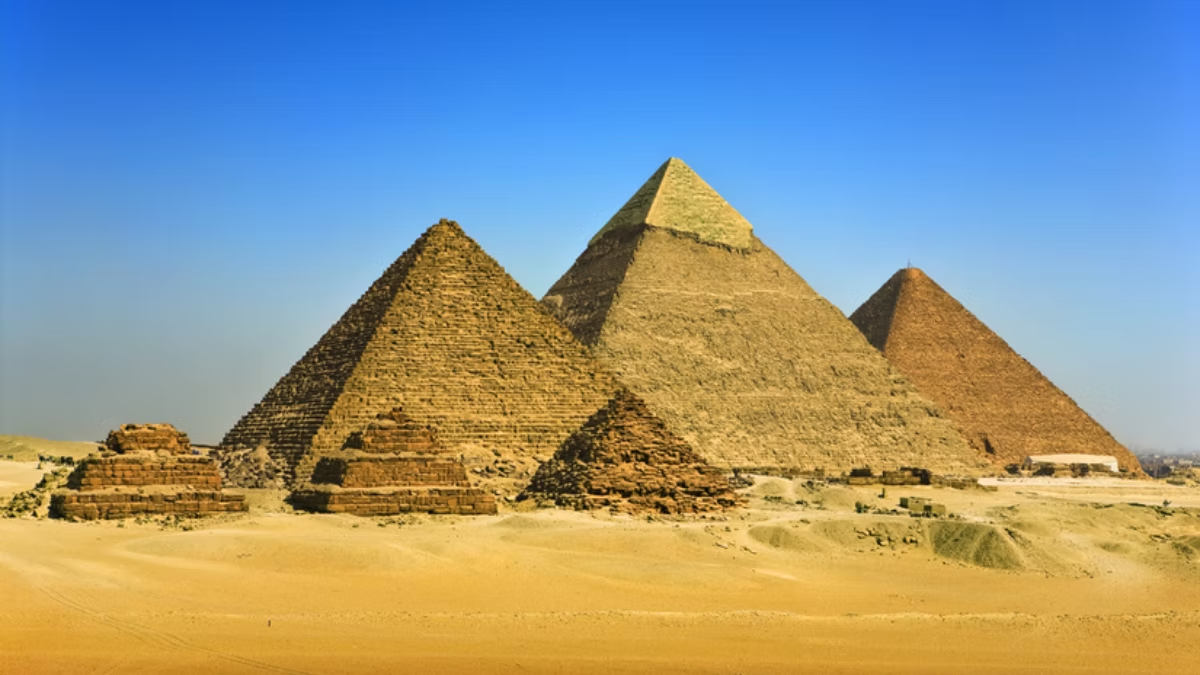
The Queens’ Pyramids at Giza are a group of smaller subsidiary pyramids built alongside the three main royal pyramids for the pharaohs’ queens, mothers, and female relatives. There are nine in total across the plateau: three associated with Khufu’s Great Pyramid (G1-a, G1-b, G1-c), one satellite pyramid for Khufu (G1-d), two associated with Khafre’s complex, and three associated with Menkaure’s pyramid. All are included with the general area entry ticket and require no additional charge to visit.
The three great pyramids of Giza are the headline act, but they are surrounded by a supporting cast of smaller monuments that most visitors walk past without stopping. The Queens’ Pyramids — nine subsidiary structures clustered around the royal tombs — are among the most undervisited sites on the plateau and among the most architecturally revealing. Standing beside one of these smaller structures and then looking back at the Great Pyramid rising behind it gives the most immediate sense of scale available anywhere at Giza. They also tell a story that the main pyramids cannot: the human world of the royal court, the women who held power within it, and the dynastic logic that placed them here.
What Are the Queens’ Pyramids?
The Queens’ Pyramids are subsidiary pyramids built as part of each pharaoh’s pyramid complex. They were intended as tombs for the pharaoh’s principal wives, mothers, and daughters — women who held significant status in the royal court and whose eternal welfare was tied to proximity to the king in death as in life.
The term “Queens’ Pyramids” is a conventional label rather than a precise description — not all of the subsidiary pyramids at Giza were built for queens. Some housed royal mothers, some were “satellite pyramids” built as symbolic second tombs for the king himself, and the identity of the intended occupants of several is uncertain or disputed. The subsidiary pyramids associated with Khufu’s Great Pyramid include one structure (G1-d) that is classified as a satellite pyramid rather than a queen’s tomb. What unites all of them is their subordinate relationship to the main royal pyramid and their position within the broader funerary complex.
Khufu’s Queens’ Pyramids (G1-a, G1-b, G1-c)
Three Queens’ Pyramids stand to the east of the Great Pyramid of Khufu, arranged in a row running north to south. They are among the most visible subsidiary structures at Giza and are passed by virtually every visitor approaching the Great Pyramid from the main entrance.
G1-a (Hetepheres I): The northernmost of the three is associated with Queen Hetepheres I — the mother of Khufu and wife of Sneferu. Her original tomb at Dahshur was robbed during her lifetime, and her burial was relocated to Giza by Khufu. A shaft tomb adjacent to G1-a contained her burial equipment — including a gilded wooden canopy, furniture, and jewellery — discovered intact in 1925 by the Harvard-Boston Expedition. The objects are now among the treasures of the Egyptian Museum in Cairo. The pyramid itself is in poor condition, its outer casing largely gone.
G1-b (Meritites I or Henutsen): The middle pyramid is attributed to either Meritites I (a principal wife of Khufu) or Henutsen (another of Khufu’s wives). Its attribution remains contested. A New Kingdom temple was later built against its east face, suggesting continued veneration of the queen buried here long after the Old Kingdom.
G1-c (identity uncertain): The southernmost pyramid’s occupant is not definitively identified. Some Egyptologists associate it with Henutsen; the precise identification depends on which queen is assigned to G1-b.
Khufu’s Satellite Pyramid (G1-d)
A fourth small pyramid — G1-d — stands at the south-east corner of the Great Pyramid complex. This is not a queen’s pyramid but a “satellite pyramid” or “subsidiary pyramid” — a symbolic second tomb for the king himself, possibly representing the king’s ka (spiritual double) or used in the funerary ritual before interment in the main pyramid. It is the best-preserved of the four small structures in Khufu’s complex.
Khafre’s Queens’ Pyramids
Two subsidiary pyramids are associated with Khafre’s complex, though neither has been definitively attributed to named individuals. They are located to the south of Khafre’s main pyramid and are among the least visited monuments on the plateau — their isolation and the lighter visitor traffic in this part of the site make them a calm spot to explore if you have time.
Menkaure’s Queens’ Pyramids (G3-a, G3-b, G3-c)
Three subsidiary pyramids stand to the south of Menkaure’s pyramid, and these are the most architecturally interesting of all the Queens’ Pyramids at Giza — in part because Menkaure’s complex was unfinished at his death and the construction state of these structures reveals the process of pyramid building in incomplete form.
G3-a is the largest and most complete of the three, intended as a true pyramid but left in a stepped form when construction ceased. It may have been intended for Queen Khamerernebty II, Menkaure’s principal wife.
G3-b is a smaller true pyramid, also unfinished.
G3-c was left as a step pyramid — the outer casing work was never completed — and was converted into a tomb by later burials, confusing the original archaeological record.
The unfinished state of these three structures is historically significant: they provide direct evidence of pyramid construction methodology, showing the stepped inner core that lay beneath the finished casing of a completed pyramid.
Visiting the Queens’ Pyramids
All Queens’ Pyramids are included in the general area entry ticket — no additional charge applies. They are among the few areas of the Giza Plateau where you can often find yourself entirely alone among ancient monuments, even on busy days.
Khufu’s Queens’ Pyramids are easily reached from the Great Pyramid’s eastern face — simply walk east from the main entrance area. Allow 15–20 minutes to walk between the three structures and read the site markers.
Menkaure’s Queens’ Pyramids require a walk to the southern end of the plateau — approximately 15–20 minutes from the Great Pyramid, or reached as part of a south-facing walk from Menkaure’s main pyramid. The three structures in their different states of completion are best visited with the context of Menkaure’s unfinished complex in mind. See our Pyramid of Menkaure guide for that background.
Photography: The Queens’ Pyramids offer some of the most striking perspective shots at Giza — looking along the row of three Khufu subsidiary pyramids with the Great Pyramid rising behind them, for example. The relative lack of visitors in this area also makes it one of the few places where clean foreground shots without crowds are possible during busy periods. See our best photo spots guide for specific viewpoint recommendations.
Why Visit the Queens’ Pyramids?
The Queens’ Pyramids are rarely highlighted in general travel guides, and most visitors on tight schedules skip them in favour of the main monuments. This is understandable — but for visitors with 5 or more hours on site, they offer three things the main pyramids do not:
Scale perspective: Standing beside G1-a and looking up at the Great Pyramid behind it makes the size difference between a “small” ancient pyramid and the Great Pyramid viscerally clear in a way that no photograph achieves.
Historical depth: The women buried here — or intended to be buried here — were central to the functioning of the Fourth Dynasty court. Hetepheres I’s burial equipment, now in the Egyptian Museum, is among the finest examples of Old Kingdom craftsmanship known. The Queens’ Pyramids are a doorway into the human world behind the monuments.
Quiet: In a site that can feel overwhelmingly busy at peak hours, the Queens’ Pyramids area remains one of the calmest corners of the plateau.
Frequently Asked Questions
How many Queens’ Pyramids are there at Giza?
There are nine subsidiary pyramids in total across the Giza Plateau. Three are associated with Khufu’s Great Pyramid (G1-a, G1-b, G1-c), one is Khufu’s satellite pyramid (G1-d), two belong to Khafre’s complex, and three stand to the south of Menkaure’s pyramid (G3-a, G3-b, G3-c).
Do the Queens’ Pyramids require a separate entry ticket?
No — all Queens’ Pyramids are included in the general Giza Plateau entry ticket at no extra charge. They are accessible as part of your standard visit without any additional fees or permits.
Which queen is buried in the northernmost pyramid next to the Great Pyramid?
The northernmost pyramid (G1-a) is associated with Queen Hetepheres I, the mother of Khufu and wife of Pharaoh Sneferu. Her burial was relocated to Giza after her original tomb at Dahshur was robbed, and a shaft tomb adjacent to G1-a was discovered intact in 1925 containing her gilded furniture and jewellery, now housed in the Egyptian Museum in Cairo.
What is the satellite pyramid (G1-d) next to Khufu’s Great Pyramid?
G1-d is not a queen’s tomb but a symbolic second pyramid built for the king himself — possibly representing Khufu’s ka (spiritual double) or used in funerary rituals before his interment in the main pyramid. It is the best-preserved of the four small structures in Khufu’s complex.
Why are Menkaure’s Queens’ Pyramids historically significant?
Menkaure’s three subsidiary pyramids (G3-a, G3-b, G3-c) were left unfinished at his death, making them uniquely valuable to archaeologists. Their incomplete state exposes the stepped inner core that lay beneath a finished pyramid’s casing, providing direct evidence of how the ancient Egyptians actually constructed these monuments.
How long should I allow to visit the Queens’ Pyramids?
Allow 15–20 minutes to walk between Khufu’s three eastern subsidiary pyramids, plus another 15–20 minutes of walking time to reach Menkaure’s three pyramids at the southern end of the plateau. Visiting all the Queens’ Pyramids comfortably fits into a visit of 5 or more hours on site.
Are the Queens’ Pyramids crowded?
The Queens’ Pyramids are among the least crowded areas on the Giza Plateau, even on busy days. Their relative obscurity means it is often possible to explore them in near-solitude, making them one of the few places at Giza where crowd-free photographs are achievable during peak visiting hours.
