

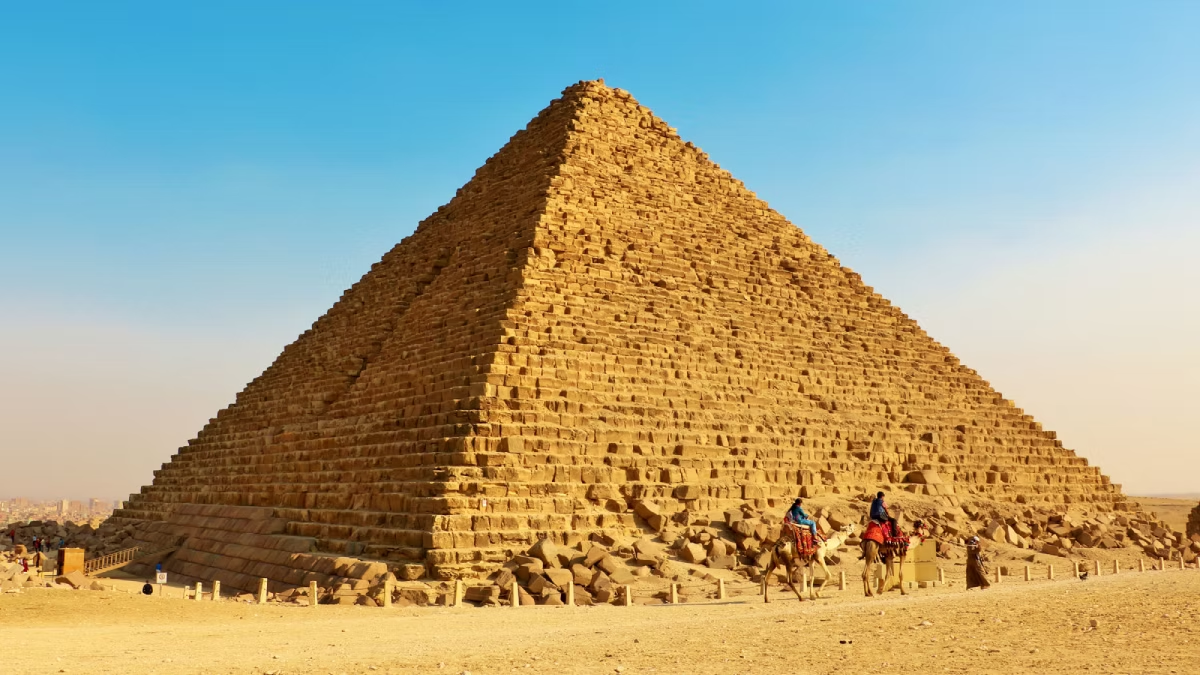
Pyramid of Menkaure — History, Facts & Complete Visitor Guide 2026

The Pyramid of Menkaure is the smallest and southernmost of the three main Giza pyramids, built for Pharaoh Menkaure (grandson of Khufu) around 2510 BC. It stands 65 metres tall — less than half the height of the Great Pyramid — and retains portions of its original granite casing stones at its base, the only pyramid at Giza with granite rather than limestone casing. The interior is accessible to visitors. Three smaller satellite pyramids stand to its south, associated with Menkaure’s queens. Despite its smaller size, Menkaure’s pyramid is the most intimate and approachable of the three.
The Pyramid of Menkaure is the smallest of the three main Giza pyramids, and it is often the one that surprises visitors most. After the overwhelming scale of Khufu and Khafre, Menkaure’s pyramid has a different quality — more approachable, more human in scale, and surrounded by the three smaller satellite pyramids of his queens in a way that makes the whole complex feel more intimate. The granite casing stones at its base — darker and rougher than the limestone of the larger pyramids — give it a distinctive visual character, and the interior, while simple, is accessible and less physically demanding than the Great Pyramid.
Key Facts
| Fact | Detail |
|---|---|
| Pharaoh | Menkaure (also known as Mycerinus) |
| Dynasty | Fourth Dynasty, Old Kingdom |
| Built | c. 2530–2510 BC |
| Original height | 65 metres |
| Current height | 61 metres |
| Base length | 102.2 metres per side |
| Casing material | Red Aswan granite (lower courses), white limestone (upper) |
| Interior access | Yes |
| Satellite pyramids | Three (Queens’ Pyramids) |
Why Is Menkaure’s Pyramid So Much Smaller?
The dramatic reduction in size from Khufu to Khafre to Menkaure is one of the most frequently asked questions at the Giza Plateau. The answer is not a decline in power or ambition — it reflects a deliberate shift in royal resources and priorities.
The Pyramid of Menkaure is significantly smaller than those of Khufu and Khafre primarily because the Old Kingdom’s economic and organisational resources had been strained by two generations of pyramid building at the colossal scale. Menkaure may also have chosen to redirect resources toward the elaborate finishing of his mortuary complex — his Valley Temple produced some of the finest Old Kingdom sculpture ever discovered, including a series of exquisite slate triads depicting Menkaure flanked by the goddess Hathor and various nome deities, now displayed in the Egyptian Museum and the Museum of Fine Arts in Boston.
The choice of red Aswan granite for the lower casing courses — an expensive material quarried 800 km south and transported by river — suggests that quality and prestige, rather than sheer size, were Menkaure’s priorities.
History and Context
Menkaure was the son of Khafre and grandson of Khufu. He ruled for approximately 18–22 years. Ancient sources record him as a just and popular ruler — a sharp contrast to the reputation of his grandfather Khufu, who Greek and later classical sources described as tyrannical (almost certainly an exaggeration or later legend). The Turin King List and Manetho both portray Menkaure favourably.
His pyramid complex was unfinished at the time of his death — the granite casing of the lower courses was in place, but the upper portion was completed in mudbrick by his successor Shepseskaf rather than stone, and the mortuary temple was similarly completed in simplified form. The complex was finished and dedicated by his successor, reflecting the practical realities of pyramid construction across a single reign.
The Interior
The interior of Menkaure’s pyramid is the most accessible of the three main Giza pyramids — less steep and confined than the Great Pyramid, and with a slightly larger passage profile. It contains a decorated antechamber with carved false-door panels (the panels themselves were removed to museums, but the carved recesses remain), and a burial chamber lined with granite. A decorated basalt sarcophagus was discovered in the burial chamber in the 19th century; the ship transporting it to England sank off the Spanish coast in 1838 and the sarcophagus is lost.
The interior ticket price for Menkaure’s pyramid is lower than for the other two — confirm the current rate at the site ticket office, as it is subject to revision.
The Queens’ Pyramids (Satellite Pyramids)
Three smaller satellite pyramids stand to the south of Menkaure’s main pyramid, associated with his queens or female relatives. These are among the most complete examples of subsidiary pyramid construction at Giza and give a vivid sense of how the royal pyramid complex functioned as a family monument rather than an individual tomb. See our full Queens’ Pyramids guide for detailed coverage of all satellite pyramids at Giza.
Visiting the Pyramid of Menkaure
Menkaure’s pyramid is the furthest south of the three main pyramids and requires the longest walk from the main entrance gate — approximately 15–20 minutes on foot from the Great Pyramid, or a short drive on the internal site road.
Best approach: Walk along the western side of the plateau from Khafre’s pyramid toward Menkaure’s, then continue to the Queens’ Pyramids area and the panoramic desert viewpoint to the south — this route covers the full sweep of the Giza complex in a single south-facing walk.
Best photography: From the north-east, showing the granite casing stones of the lower courses against the lighter limestone above. Early morning and late afternoon light brings out the texture and colour contrast of the two materials particularly well. See our best photo spots guide for exact viewpoint recommendations.
Frequently Asked Questions
Can you go inside the Pyramid of Menkaure?
Yes, the interior of Menkaure’s pyramid is open to visitors with a separate interior ticket, priced lower than the entry fee for the Great Pyramid. The passage is less steep and more spacious than the Great Pyramid’s, making it the most accessible of the three main Giza pyramids to enter. Confirm the current ticket price at the site ticket office, as rates are subject to change.
Why is the Pyramid of Menkaure so much smaller than the other Giza pyramids?
The smaller size reflects a deliberate shift in priorities rather than a decline in power — two generations of colossal pyramid building had strained Egypt’s organisational and economic resources by Menkaure’s reign. Menkaure appears to have redirected resources toward quality over scale, choosing expensive red Aswan granite (quarried 800 km to the south) for the lower casing courses and commissioning some of the finest sculpture of the Old Kingdom for his Valley Temple complex.
How tall is the Pyramid of Menkaure?
The Pyramid of Menkaure originally stood 65 metres tall; it now stands approximately 61 metres due to erosion and stone removal over the centuries. That makes it less than half the height of the Great Pyramid of Khufu, which originally reached 146 metres. Its base measures 102.2 metres per side.
What are the three smaller pyramids next to Menkaure’s pyramid?
The three smaller structures to the south of Menkaure’s pyramid are known as the Queens’ Pyramids, built for his queens or female relatives. They are among the best-preserved examples of subsidiary pyramid construction at Giza and illustrate how the royal complex functioned as a family monument rather than a single tomb. All three are visible from Menkaure’s pyramid and can be explored as part of the same southward walk across the plateau.
How far is the Pyramid of Menkaure from the main Giza entrance?
Menkaure’s pyramid is the furthest south of the three main pyramids and takes approximately 15–20 minutes to reach on foot from the Great Pyramid area. Visitors can also use the internal site road for a short drive. The recommended approach is to walk south along the western side of the plateau from Khafre’s pyramid, continuing on to the Queens’ Pyramids and the panoramic desert viewpoint beyond.
What happened to the sarcophagus found inside Menkaure’s pyramid?
A decorated basalt sarcophagus was discovered in the burial chamber of Menkaure’s pyramid in the 19th century. It was loaded onto a ship bound for England in 1838, but the vessel sank off the Spanish coast and the sarcophagus was lost at sea — it has never been recovered. The granite-lined burial chamber and a carved antechamber with false-door recesses remain visible inside the pyramid today.
When was the Pyramid of Menkaure built, and who was Menkaure?
The Pyramid of Menkaure was built around 2530–2510 BC during Egypt’s Fourth Dynasty. Menkaure was the son of Pharaoh Khafre and grandson of Khufu, and ancient sources — including the Turin King List and the historian Manetho — describe him as a just and popular ruler. His pyramid complex was unfinished at his death and was completed by his successor Shepseskaf using mudbrick for the upper casing rather than stone.
